The Power of Brainstorming: Why Every Professional Needs It (and How to Do It Right)


If you’ve heard of brainstorming but never paid much attention to it because it sounded like some outdated method from university group projects, it’s worth looking at it from another angle.
For professionals in different fields, brainstorming can be genuinely useful. When done well, it helps teams make decisions faster, build better alignment, and find solutions that one person alone might never reach.
Let’s look at why brainstorming can become your trusted method, how to brainstorm in a way that actually works, and how to do effective brainstorming at work.
What is brainstorming — really?
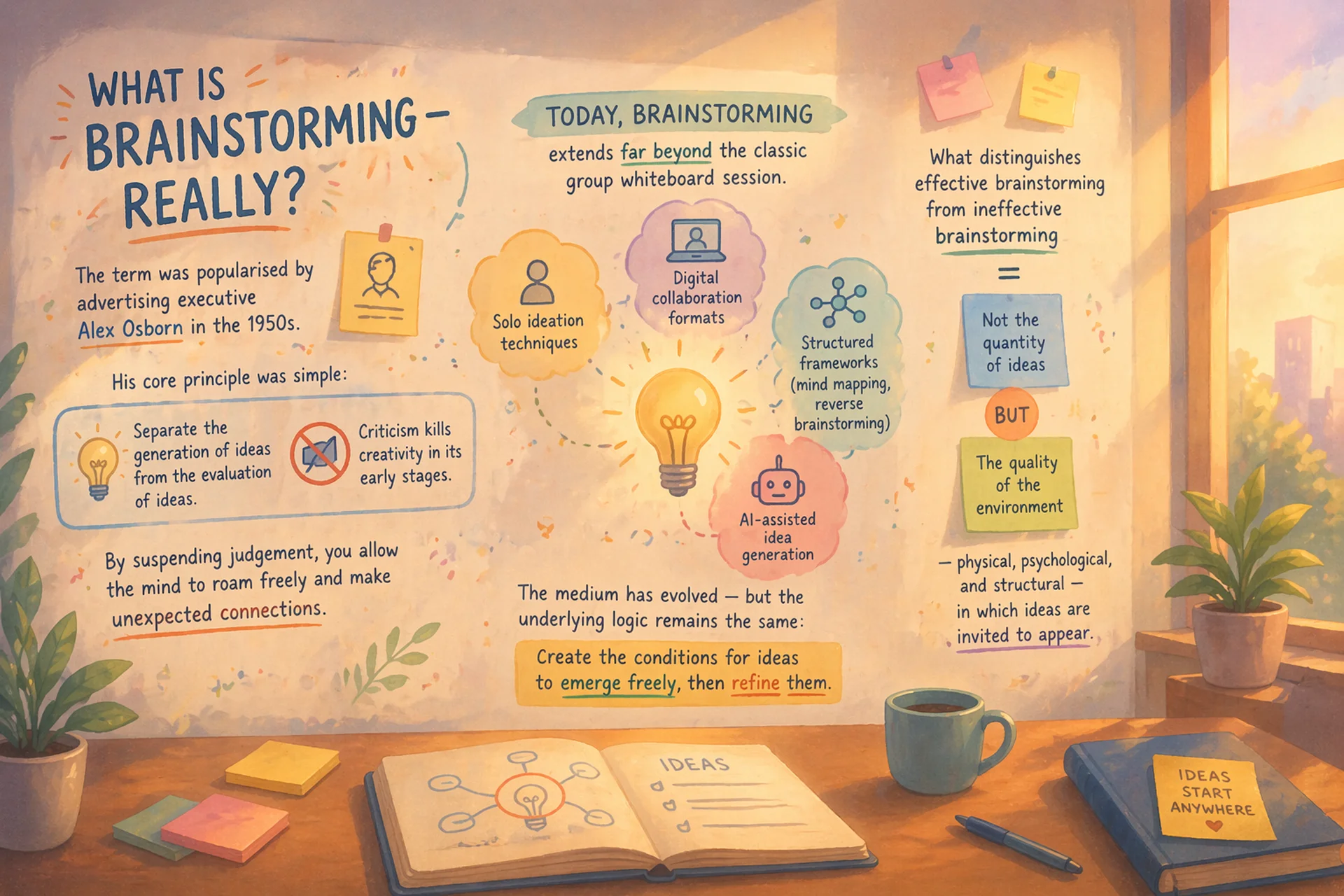
Today, brainstorming extends far beyond the classic group whiteboard session. It includes solo ideation techniques, digital collaboration formats, structured frameworks like mind mapping or reverse brainstorming, and AI-assisted idea generation. The medium has evolved — but the underlying logic remains the same: create the conditions for ideas to emerge freely, then refine them.
What distinguishes effective brainstorming from ineffective brainstorming is not the quantity of ideas, but the quality of the environment — physical, psychological, and structural — in which ideas are invited to appear.
Why brainstorming matters for professionals
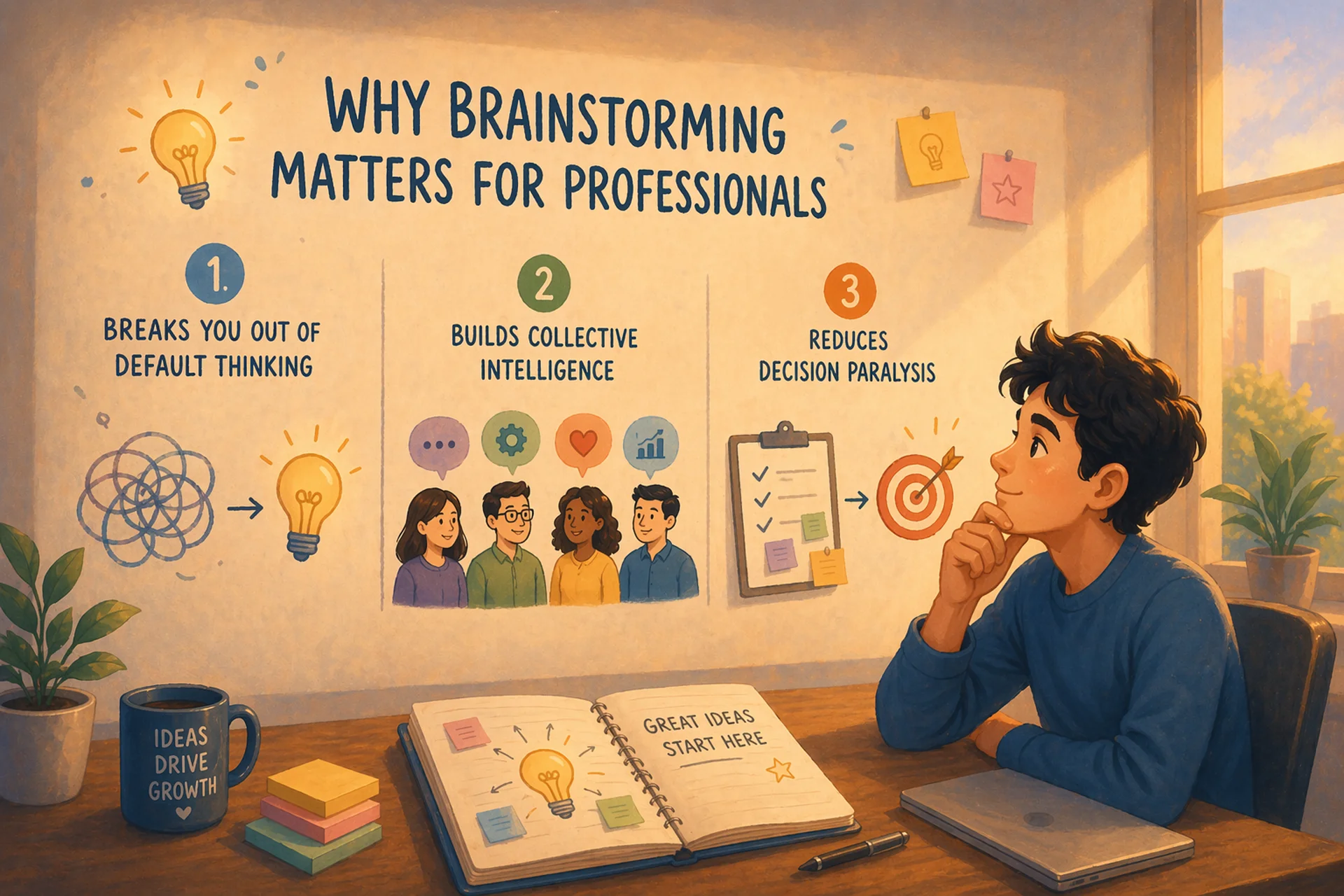
In modern teams, brainstorming at work is not just a creative exercise. It is a practical way to solve problems, make decisions, and bring different perspectives together.
1. It breaks you out of default thinking
The human brain defaults to familiar patterns. Under time pressure, we tend to reach for the solution that worked last time — even when circumstances have changed. Brainstorming deliberately disrupts this tendency by prompting quantity over quality in the early phase, forcing the mind to keep generating beyond its comfort zone.
Research in cognitive science consistently shows that idea generation improves when people are encouraged to explore beyond their first three to five responses. The most original ideas typically emerge later in a brainstorming session, once the obvious ones have been cleared away.
2. It builds collective intelligence
No single professional has a complete view of a problem. Marketing sees things that operations misses. Junior staff notice friction that leadership overlooks. Brainstorming is one of the few workplace formats that actively invites diverse perspectives into the same conversation at the same time.
When team members build on each other’s ideas — a process researchers call “cognitive stimulation” — the group consistently outperforms any individual contributor. The result is not just better ideas, but stronger team alignment around the direction chosen.
3. It reduces decision paralysis
One of the most underrated benefits of a well-run brainstorm is what it does to decision-making. When a team has visibly explored many options before selecting one, there is greater confidence in the final choice. Doubt is reduced because alternatives were genuinely considered, not dismissed out of hand.
This is particularly valuable in high-stakes environments — product launches, strategic pivots, crisis response — where the cost of a wrong decision is high and the pressure to act quickly is real.
4. It fuels innovation over time
Organisations that practise regular brainstorming develop what might be called an “innovation muscle.” Teams become faster at generating ideas, more comfortable with uncertainty, and more willing to propose unconventional solutions. Over time, this translates into a measurable competitive advantage — not because every brainstorm produces a breakthrough, but because the cumulative habit builds creative capacity across the whole organisation.
How to run a brainstorming session
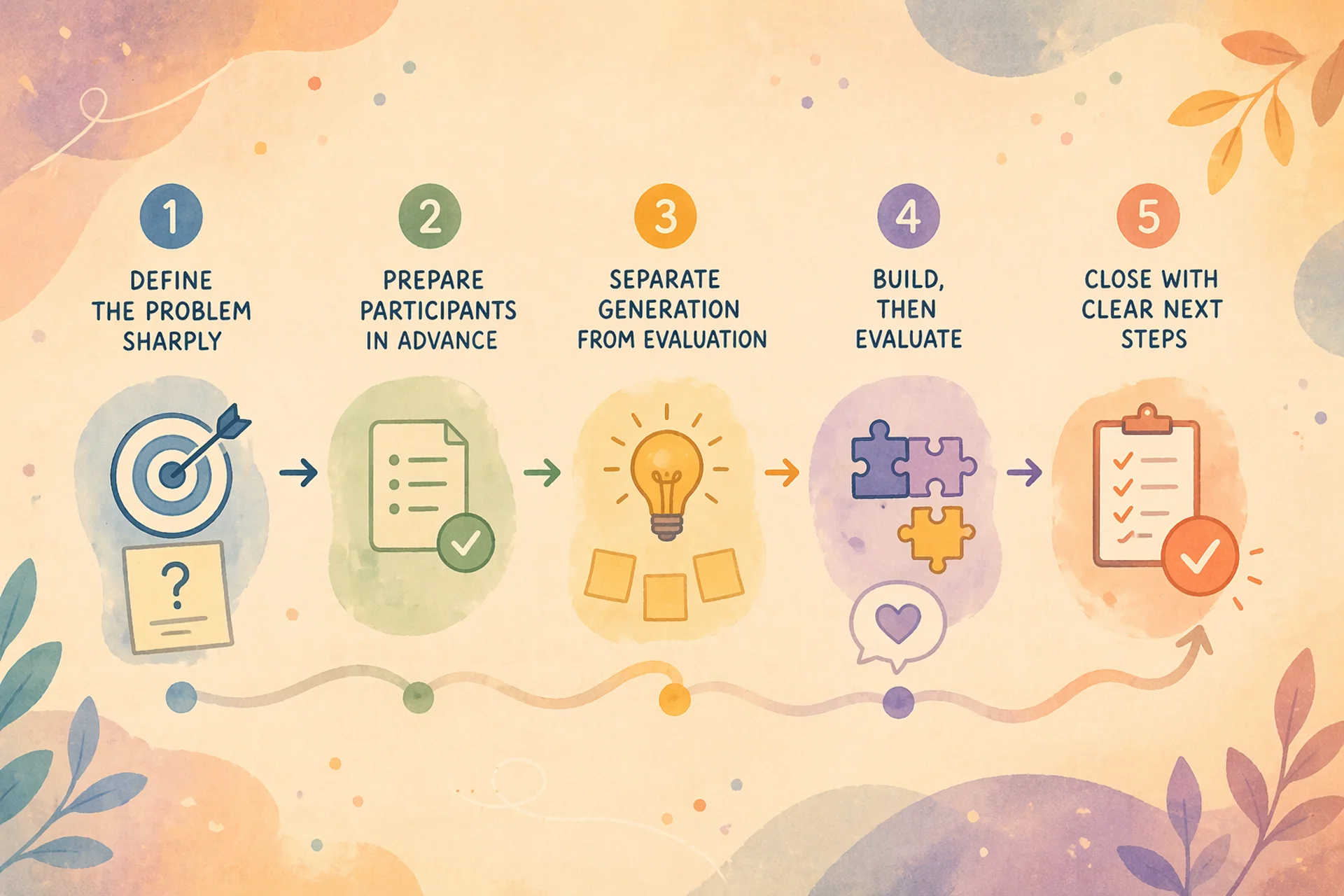
Most brainstorming sessions fail not because the participants lack ideas, but because the structure fails them. Here is a framework that works consistently across industries and team sizes.
Step 1: Define the problem sharply
A vague prompt produces vague ideas. Before the session begins, craft a specific, action-oriented question. Instead of “how do we improve our product,” try “what would need to be true for a first-time user to recommend us within 48 hours?” The sharper the question, the more focused the output.
Step 2: Prepare participants in advance
Share the brainstorming prompt at least 24 hours before the session. Ask participants to arrive with three to five initial ideas already written down. This prevents the session from being dominated by whoever speaks first, and gives quieter team members equal footing from the start.
Step 3: Separate generation from evaluation
Run the ideation phase in complete silence, if possible. Each person writes their ideas independently before any group sharing begins. This is known as “brainwriting” and it dramatically reduces groupthink and anchoring bias — two of the most common killers of creative output in group settings.
Step 4: Build, then evaluate
Once all ideas are visible, open the floor for building on them — not criticising them. Encourage “yes, and” responses rather than “yes, but.” Only after this building phase should the group begin evaluating and narrowing down.
Step 5: Close with clear next steps
A brainstorm without follow-through is just a conversation. Before the session ends, assign ownership to the top ideas: who will develop this further, by when, and how will progress be tracked? This transforms creative energy into actionable momentum.
Common brainstorming mistakes to avoid
Even good brainstorming session ideas for work can fail if the process is unclear.
- Starting with evaluation. The moment someone says “that won’t work” in the ideation phase, the session is effectively over for the shyer participants in the room.
- Running the session without a facilitator. Unstructured brainstorms are dominated by the loudest voices. A designated facilitator keeps the process fair and productive.
- Treating every brainstorm the same. Different challenges call for different formats. Strategic problems may need divergent techniques like SCAMPER or reverse brainstorming. Execution problems may simply need rapid ideation followed by quick voting.
- Not documenting the output. Ideas not captured are ideas lost. Every session needs a written record, however rough.
How Letterly supports your brainstorming process
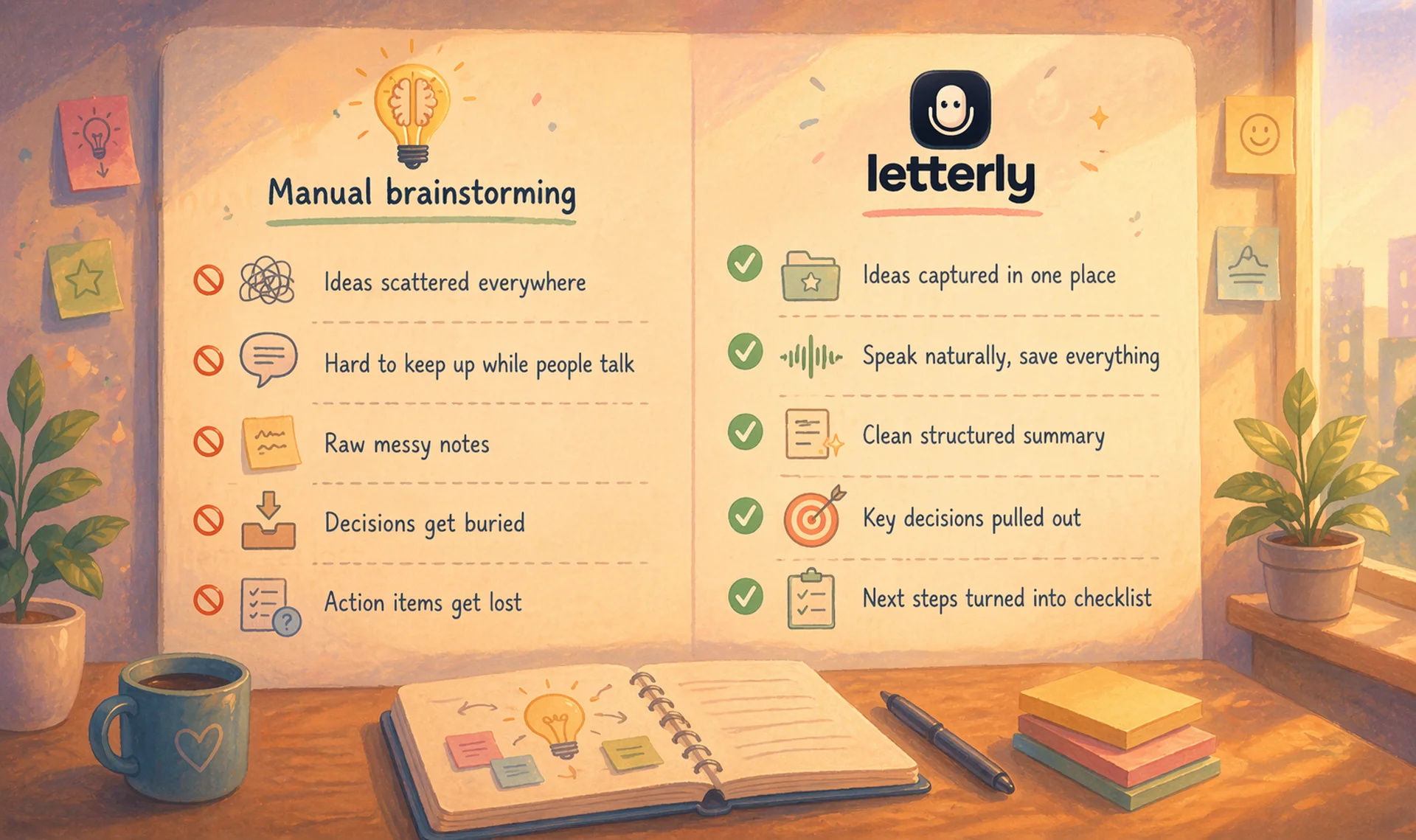
As we discussed earlier, one of the most common problems with brainstorming at work is losing the output of the session. That’s why it’s important to use a tool that helps you capture and keep those ideas.
Letterly helps professionals capture ideas before they disappear. You simply speak your thoughts, and Letterly turns your voice into clear, structured text.
This is especially useful for brainstorming. Instead of trying to type notes while thinking, you can talk freely, record ideas as they come, and then get a readable version you can review, edit, share, or turn into next steps.
It is not a replacement for creativity or team discussion. It helps you keep the output of that thinking. With Letterly, messy spoken ideas can become notes, summaries, action points, or drafts you can actually use later.
For professionals who brainstorm often, this makes the whole process much easier: fewer lost ideas, less manual note-taking, and a clearer record of what was discussed.
Hope this guide helps you get more out of your brainstorming sessions.
Got questions? Email us at hi@letterly.app – we’re happy to help.